EDITING
Editing Research - Jan 21st 2019
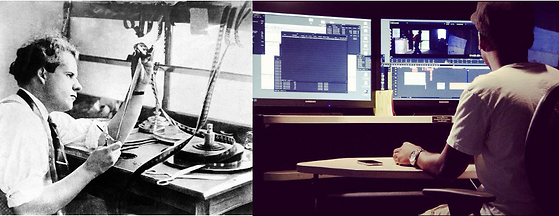
Looking at the two images, outline the differences between them (use bullet points)
-
old and new/modern
-
the materials and equipments
-
computer screens
-
the guy that's using the equipments
Editing is another micro element of film making.
"It is the activity of selecting the scenes to be shown and putting them together to create a film."

FACTS ABOUT FILM MAKING - What statement is the most interesting and why?
I think the last picture that quotes on what filmmaking is most interesting to me. The first reason is because it's factual and it gives the idea to the reader of how filmmaking is produce. Second reason is because of the ending sentence. The idea behind this quote about how filmmaking is produced is something I agree on and can sympathise with.
Who is in the Editing team and what is the chain of command?
Film Editor -> Data manager (manages the 'rushes', raw footages) -> VFX supervisor -> Colourist -> Editor assistant and trainees

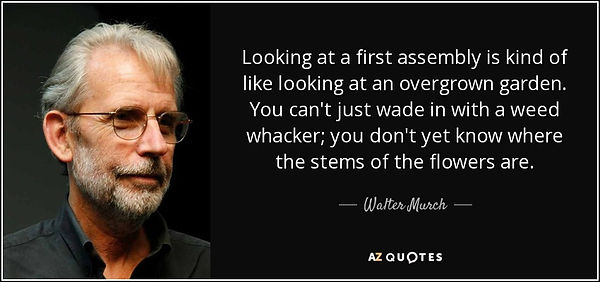

In your own words explain who is in control of film editing and what is the most important aspect according to Walter Murch and why?
The video editor/director is in control of film editing and according to Walter Murch, emotion is the most important aspect of editing, because as filmmakers we are trying to manipulate how the audience feels and what the audience remembers most after watching a film is their emotions and how they felt about it.
5 TYPES OF EDITING
1. Continuity editing
2. Radical Subjective Continuity/ Dis-Continuity/Disjunctive editing
3. Classical editing
4. Thematic of Montage editing
5. Soviet Montage theory
CONTINUITY EDITING
"A system of cutting used to maintain a continuous and clear narrative action by following a set of rules."
Rules:
- Establishing shot
- Shot/reverse shot
- 180-degree rule
- 30-degree rule
- crosscutting
- match on action
- eyeline match
- re-establishing shot.
The benefits:
- The narrative has a structure
- The shot sequences flow seamlessly into each other
- It is easy to watch the film.
CLASSICAL EDITING - 23.Jan.2019
First popularized by D.W. Griffith is used to draw views into the emotional of the scene. This style jumps from the 'master shot' (long/wide shot) to the medium shot and then close-ups to draw the audience psychologically closer for dramatic effect.
This style is achieved through 'coverage' the process in which a scene is filmed from a variety of angles, for example 'eye line match' - if we see an actor refer to something off screen, this object is filmed through 'cutaways' -coverage of items. 'Matched actions' - cut happens during a major action, this adds emphasis to an action.
MONTAGE/THEMATIC EDITING
From the French, Monter, meaning to assemble. MONTAGE capitalizes on our brain's ability to associate ideas. Edits that are driven by a particular theme, it is often a rapid sequence of shots designed to elicit feelings or call upon common experiences. The cuts are motivated by a connection of ideas, not by the continuity of time and space. It could be used t show the passing of time.
The Kuleshov Effect - explained
Shot A and shot B is associated in a way that the audience believes they are of continuity and are related with each other. It creates meaning from one another. No matter what the actor does, meaning can be created or manipulated with editing by putting two shots together.
It is effectively achieved by following the eye line of the character to make the audience see what the actor is seeing. Sometimes two shots could be unassociated to create confusion. A failure is when confusion is created when it is unintended. Sometimes confusion is an aesthetic choice. When a frame is cartoonized or puts an effect over it, the audience finds it easier to accept the confusion.
SOVIET MONTAGE THEORY
Montage is associated with Soviet cinema 1920's film makers especially Lev Kuleshov, V.I Pudovkin and Sergei Eisenstein.
Kuleshov's famous experiment which was later termed the Kuleshov effect was a breakthrough in understanding and producing films.
CASE STUDY - WALTER MURCH
Name: Walter Scott Murch
D.O.B: July 12 1943
Place of Brith: New York City, America.
First film edited: The Rain People (1969)
First sound edited: The American Graffiti (1973), The Godfather II. (1974)
First Academy Nomination: The Conversation (1974)
First Oscar won: Apocalypse Now (1979)
Double Oscar winner: Best Editing, Best Sound with The English Patient (1996)
RADICAL SUBJECTIVE CONTINUITY / DIS-CONTINUITY / DISJUNCTIVE EDITING
Cuts of different time and space for dramatic effect. Spatial and temporal discontinuity. The established editing rules are not followed. This can also be called "visible" editing; editing that calls attention to itself and violates the views expectations of continuity.
The film that invented Jump Cut.
Associative/abstract editing
Once again stemming from the Kuleshov effect, associative and abstract editing focuses on a juxtaposition of two shots that when combined have meaning (but separate, they do not)
Metric montage
- each character have an equal amount of screen time (the karate kid)
Rhythmic montage
- creates visual continuity
tonal montage
- the tone is melancholic as is brought through the emotional response of the actor?
over-tonal montage
- concerning montage of large sequences.
intellectual montage or ideological
- metaphoric cuts and shots to represent the meaning
Watch the following "Battleship Potemkin" clip and evaluate how effectively the meaning is communicated through the editing?
EDITING - WHAT MEANING
Classical editing, put two shots together. tell a story. the kulshov effect. associate them together. gunshots people running. long shot, close up. soviet montage. eisenstein. continuous editing. shows the story of what's happening. emotional response. silent film. cutting to dialogue. gun shooting - people dying. its a strange pace with the music.
key terms needed
what meaning is created
unjustice
// power abuse // dictatorship, gun abuse, people dying.
Watch the following "Requiem of a Dream" clip and evaluate how effectively the meaning is communicated through the editing?
The montage in this extract from Requiem for a Dream is used to make repetitions to create the meaning of the consistent usage of drugs of the characters. Repetition is the best way to manipulate the audience's mind and the persuade them to understand and feel what the story or meaning is. Montages are just a series of shots put together that is motivated by the connection of idea more than time and space. For example in this drug sequence, the montage of what happens when consuming drugs is shown for both men and women to tell the audience about the collective idea of how drugs are consumed by both gender, then later as the montage goes on, we see the passing of time of how these people continue to use drugs and how they get high on it and how it affects their inner cells as well as their outside life. Drugs are an addictive substance, and with this idea of repeated montage, the idea is further enhanced to the audience about how drugs became a vital part of the people's lives. The meaning is effectively created because I think the editor makes good use of the logic behind repetition of manipulating the audience's opinion about drugs from their prior knowledge and it gives the audience gratification about having an opinion on this and being able to talk about it in the society.
Cutaways shots are also frequently used in this montage to show the meaning/idea of secrecy in the drug industry and how it is hidden from the outside world yet so frequently used. In cutaways, the shot is used to stray away from the main story or to focus on an object rather than a subject of the film. In this drug sequence, the idea of cutaways is ironically used as a major flow of the plot rather than just showing the characters and following their plan of actions. This creates an emotional response and manipulates the audience to think about how the idea of drugs is highlighted in this scene. For example, when there was a scene about how the drugs are traded with money in secrecy, the shots put together flows in a certain sequence (and then repeated) to show how the money and the weed are used to get to the consumer and the provider. Such as the money being hidden under a dustbin, hiding it in the pocket and so on. The focus is on the secrecy of the drug dealing which creates a juxtaposition to induce an emotional response.
The meaning of injustice is created in this extract of Battleship Potemkin through the use of continuous editing. Continuous editing is where a story is created through the flow of the shots that are put together and follows a certain set of rules and sequence to tell a story to the audience. For example, in this silent film Battleship Potemkin, continuous edits can be seen when there is time for dialogue from the characters. There seemed to be a small plot going on when the poor citizens were begging the guns to stop and the mother begged for her son's safety. We can clearly see that the army of guns are used to shoot the innocent citizens and by putting the shot of the citizen's dying and fleeing, the audience can associate that the citizens are innocent and are scared of their death. This is the Kulshov effect where the shots of the gun shooting and the people dying are to show the audience that they are related to manipulating emotions to us (as stated by Walter Murch, emotion is the most priority when it comes to editing). The meaning is effectively created because the editing triggers the feeling of injustice as the crying actors in the scenes correlates with the shooting guns.
The editor Eisenstein mainly uses the method of Soviet Montage, more of over tonal montage and the use of Kulshov theory to indicate the meaning of gun abuse and dictatorship. The gun is absolute.
repetition is the best way to manipulate the audience.
rythmic montage.
not really a continuous editing. but kinda create4s a story/meaning. of what goes on in drug industry.
not really classical. a lot of cutaways. the montage kind progresses to show how the drug is addictive.
EDITING PROCESS
This is the first stage of post-production. A series of footages are put together according to the storyboard. The final editing is done together to make sure the footages are in order and the composition is not to be changed; this is called a picture lock. After the picture lock, we then move onto sound.
FIRST ASSEMBLY
The first assembly is based on the storyboard and it's the first editing of our film. We will share it with our class to get feedback. This feedback will then influence our decisions for future edits.
For the very first step, I collected all the clips we have taken over the course of 3 weeks into one folder from 2 different SD cards as we used 2 different cameras. I was the main cameraman, so I took the responsibility of looking through all the rushes that we had before handing them to our editor. There were some repeated clips as I took many takes for one scene. But I did not delete them as I wanted to leave it for the editor to judge.


After all the rushes has been sent to the editor, the first thing we were supposed to do was a first assembly 'picture lock'. It was to align all the used footages into the order of the shot list.
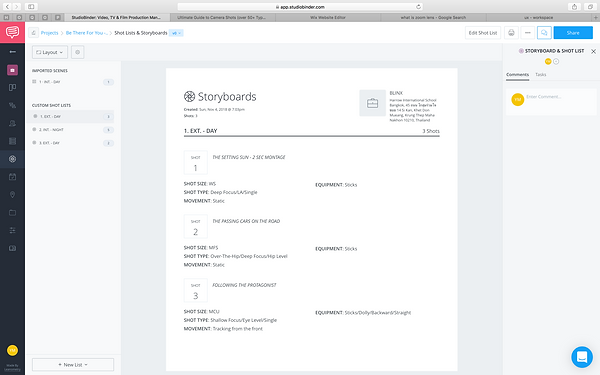

I believe the communication between our members were well established as the editor, Prim had aligned the shots according to the shot list that has been provided and produced by the team. We also decided since the first that we would be using voice over to assist the video. The very first storyboard/script/shot list that we made was really different from the final plan that we agreed on. The voice over was not recorded at first but the editor had already set the pace of the film by putting the raw footages together.
Then Prim had further fixed it by changing the pace of the opening scene, where we see the protagonist walking across the school wall in rather slow motion. It had been added for a more dramatic effect and the narration would follow after.


The editor has added an opening ident and corresponding title typography at the end to give our production company a 'brand'. This is to add to the meaning of a 'romantic comedy-drama' where we see a lot of films (in Thailand or Korea) always do the same to differentiate themselves from other similar films. Our aim was to make it as clique as possible, yet maintaining originality and creativity.


The use of letterbox in our film was to add extra cinematic effect and to make it look more dramatic than it seems. Even though our genre is romance comedy-drama, our opening sequence has a lot of serious tone to it. The addition of letterbox has made it more dramatic and serious in that sense. There was supposed to be some iron in it as we are aiming for comedic reactions while also enhancing the effect of contrast to effectively convey the meaning to the audience.
First assembly
First assembly feed back (from peers and teacher)
what went well:
-
color grading
-
acting/performance
-
use of Thai language
-
clear narrative - easy to understand
-
tone and mood and emotion is clear
-
cinematography wasn't too bad - it worked with the mood of the piece
-
lovely ident
ebi:
-
narrator voice must be clearer
-
subtitle needs to have steady layout
-
better costume and location - it was obvious that it was in Harrow
-
different use of setting would have been so much better
-
don't tell too much of the story
-
what could happen to make the audience want to watch the film? don't have much hook.
This is our actual first assembly without the narration and just some music/soundtrack. The first assembly video above was made with much rushing and not enough time to edit the shots and sound properly because we thought we had to be done by that time. But because of that we, have earned a lot of feedback that will make our video better. Sadly, after this, our editor Prim had left the group. We couldn't get in contact with her about the video editing anymore. Therefore, this first assembly is all that we have left to further enhance it and make it better.
SECOND CUT


As part of the second cut, I decided to follow some of the improvement that could've been made to our film. Near the ending of our opening sequence, some have spotted an editing error where the motion stopped to become a slide show. I have decided to get rid of it to ensure a smooth transition between scenes.
To edit the sequence wasn't possible in this stage and the feedback about the location and clothing choice couldn't be fixed as well as we would have to film a lot of the parts again. The actors already gave their time to film for 2 weeks and were not available for longer.
FINAL CUT - the picture lock
I've also realized that one of the weakness in our film is the poor subtitles and the lack of credit. Therefore in the final cut of our opening, I have decided to make proper captions and a unique way of adding the credits.

For the subtitles, I've used the 'Captions' layer in Premiere Pro to add on the translation of the narration (ie. the subtitle). I chose to do this rather than adding layers of text and 'titles' into our film to avoid overloading of text that could possibly build up while editing. It also avoids confusion. The Caption layer was a new discovery which also adds to my skills development.

For the credits, our teacher told us to make it as subtle as possible to not distract the audience from the scene and the subject displayed in the frame. As seen from my peers' film openings, there are frequent mentions of un-matching typography or the words itself being too big. I decided to use the tool 'Mask' to make my subtitle subtle, and unique/different from others. It also added a layer of depth to the meaning in which my teacher have reviewed it as. The use of 'Mask' was also a new task, which further added to my skills development.
Teacher's Review on the credits/mask and branding...
Apologies for the vertical video.
FINAL PICTURE LOCK
